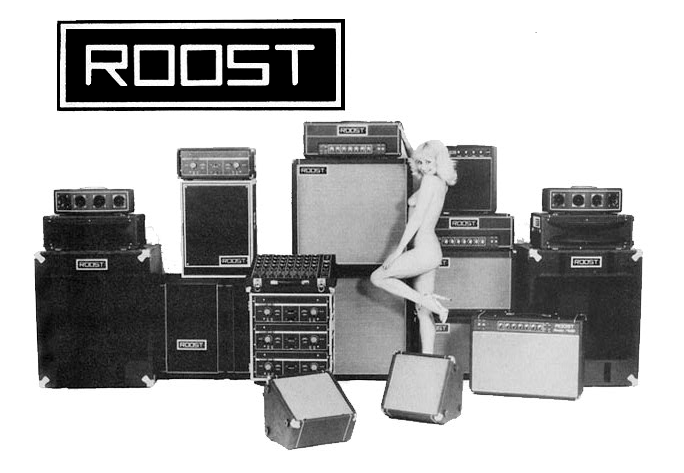
HOME | HISTORY | PICTURES | SCHEMATICS
Roost amps
history
By Terry Bateman (an ex roost employee)
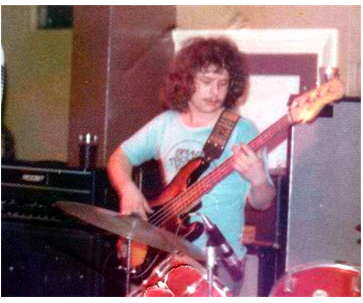
Terry Bateman circa 1978 live with Brad, brother of Robin Trower. Note ROOST ST 22 base rig with optional pint of bitter accessory.
ROOST sound equipment was started back in 1972 by Brian Roost (hence the name)
and Ron Bailey who are both local musicians based in Southend on Sea Essex. They
were also at the time fixing amps for their local music shops and bands.
The ROOST amp is similar to the Hi-Watt amplifier with a little bit of early 100w sound city amp thrown in for good measure. The early amps also use Sound City transformers as Sound City were also built in Southend at the same time. The early amps had a black engraved front panel similar to the Hi-Watt amplifier. The circuitry was built on tag panels but later amplifiers had a black screen printed metal front panel and the circuit was then built on printed circuit boards.
The range consisted of 50w, 100w and 150w amp heads with the option of reverb.
The latter units had a master control volume. There was also a range of 2×12 50w
and 100w combo amplifiers both available with reverb. There was also a range of
2x12, 4x12, 1x15 and 2x15 speakers to go with the amplifiers. Early units had
FANE speakers but the later units had Celestion. There was also the option of EV
as well.
The amplifiers were of a rugged construction with a hefty steel chassis and
large transformers. The 50 and 100 W amplifiers gave a good 50 and 100w RMS
output whilst the 150w gave 125w but it did have 6 x EL34's - the same as
the Sound City 120 head. The circuit was well engineered and gave the typical
British valve sound. The driver and output stage gave a lot of grunt typical of
the Hi-Watt and Sound City circuits. I remember the 120w amp with its 6
EL34's is making a good bass amp whilst the 50w really sang
I first got involved in ROOST in 1975 whilst at school and looking for bits.
Transformers, chassis etc to build my own guitar amplifier. I went on to spend
that summer working at ROOST and in exchange they gave me parts to build my own
amplifiers. I went on to join ROOST full-time the next year when I left school.
The experience I gained working at ROOST building amplifiers and fixing plus
hotting up other makes of amplifiers is invaluable even to this day. ROOST never
had more than eight employees in fact when I joined there were only four
employees including me.
ROOST was sold in 1980 to FAL who were based in Leeds. I was also made redundant
when ROOST was sold and so I moved on. I now work for a local hi-fi company as a
design engineer but I still fix and work on valve amplifiers for local
musicians.
Production
scale of ROOST amps
According to Terry Bateman ROOST production was fairly small in scale. I
haven’t got production details prior to 1975 when I first got involved. From
memory, when Ron Bailey took over from Brian Roost it was Ron just doing the
amplifier assembly with one guy Ray making the cabinets. Phil Jackson helping
all around with sales etc. The PCB whilst designed by Brian Roost, was
manufactured off site. The production would have gone up from early days
to when it ended for us in Southend in 1979. During late 1977 to 78, I was
doing test and development full-time +3 guys doing wiring with one guy on
chassis bashing and packing. There was two guys making the cabinets (could’ve
been three) and one girl covering cabs with vinyl etc. I suppose it’s peak
would’ve been late 1977 to mid 1978. As for quantities made I don’t really
know but amps were made in batches of 10 units once or twice a month with odd
ones made to cover an immediate demand as required. One interesting
observation I made when testing the batches of 10 is that eight would sound good
- exactly as they should, one would sound fair (though still okay) and one would
be the dogs bollocks with lots of go. Yes it went to 11!
The FAL
connection
There is a misconception going around that FAL who took over the ROOST company in
1979 had something to do with Fane, the world famous speaker manufacturing
company. According to research conducted by Andrew Kemp this is incorrect
although both were Yorkshire based companies.
FAL which is sometimes quoted as Fane Acoustic Limited was actually Futuristic
Aids Limited based in Henconner Lane Leeds while Fane was in Bradford Road
Baxley hence the misunderstanding.
The
FUNKSHUN connection
Started by local musician Doug Marriott in Northampton it had already been in
business for about eight years in a small shop at 152 Wellingborough Road before
moving into huge new premises at 158, 160, 162, 164 and 166 in April 1977.
(coffee 5p advice free) Knocking through to get large premises was
obviously a favourite occupation of ROOST dealers. To quote Honkytonk
(below) "I took over the shop next door and after awhile of having to walk
outside to get to the next door, I got fed up with it. I just knocked the walls
down and then got permission later.
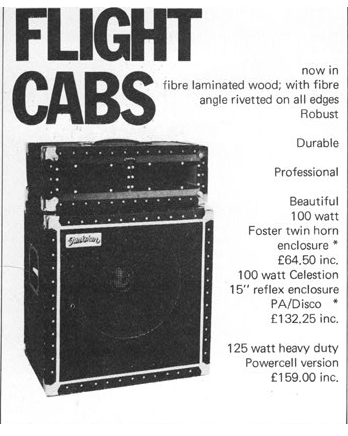
The FUNKSHUN store was run by Carrie Tyler, brother of Shaun in January 1978.
Function were talking about following their existing range of speaker cabinets
with a range of FUNKSHUN amplifiers to enhance the stores reputation. The
speakers were in fibre laminated wood with fibre angled riveted on all edges.
The shop closed in early 1990s.
Honkytonk
music connection
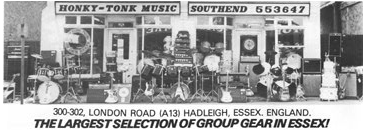
In October 1978 this Hadley Southend shop claim to be Essex‘s biggest group gear
dealer started by X professional drama Pete Brewer only three years before it
was also a hard shop and later added a recording studio.
If you look carefully you can spot at least one roost in the lineup in the 1978
photo above according to the price list they had a 100 W combo in stock at £198
just £12 cheaper than a vox AC 30